
Peach Iced Tea: Why Day-One Sensory Evaluation Is Not Enough

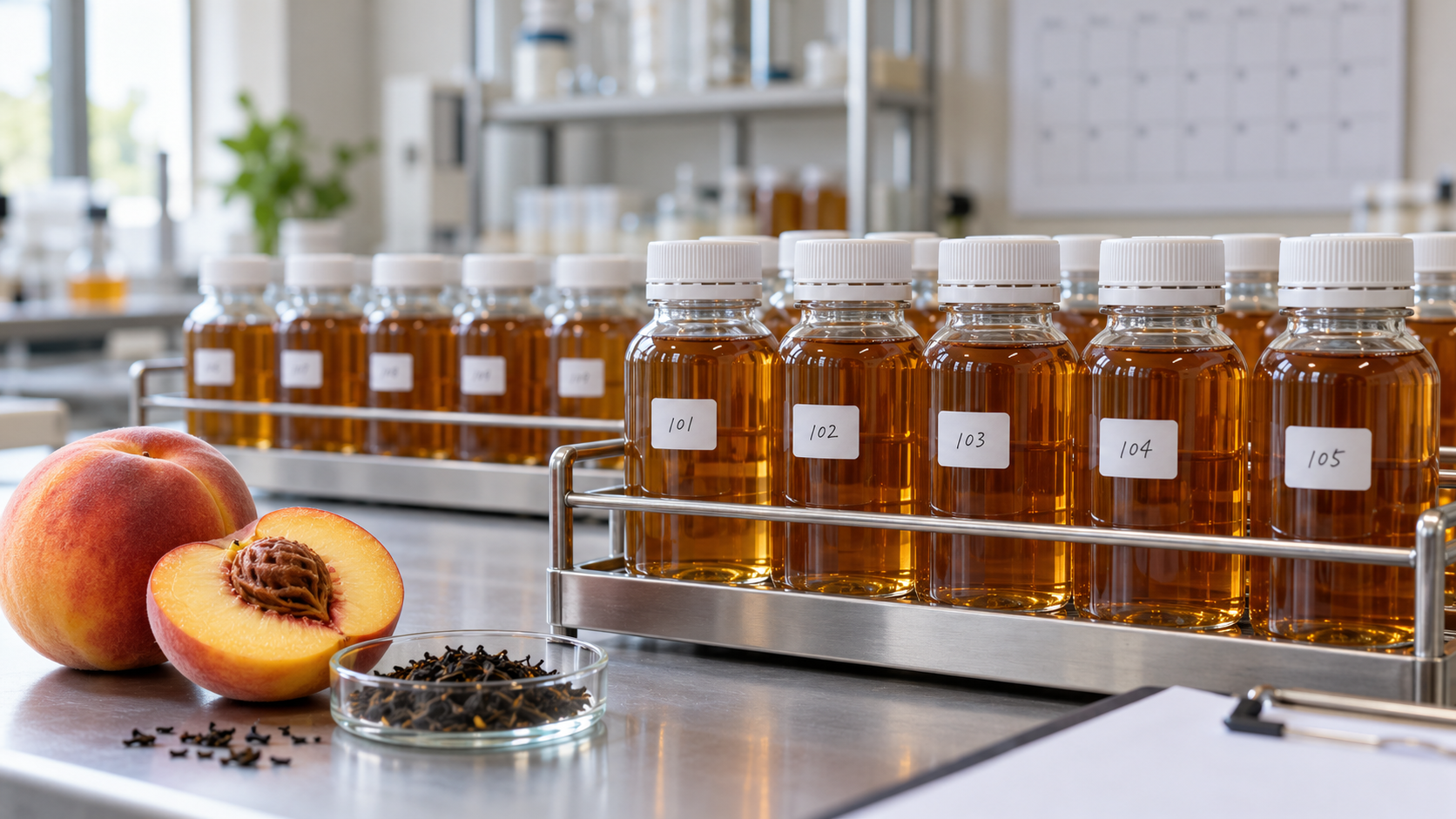
Illustrative development scene; the article presents a planning example, not reported Galbora trial results.
A good first tasting is the baseline
The peach note is clear, the tea character is balanced and the finish is pleasant. That is a useful first result. It tells the team how the prototype tastes at that point; it does not show how the same product will taste after distribution and storage.
For ready-to-drink peach iced tea, the next useful development tool is a storage evaluation plan. Its purpose is to identify what changes, when the change becomes relevant and which formulation or packaging question should be investigated. The plan below uses relative stages rather than prescribing a shelf life. The actual dates and conditions must be set for the specific product.
1. Define the product and the question
Start with one clearly identified formulation, process and pack. Record the tea base, peach flavouring code and lot, sweetening system, acid system, relevant product measurements, processing route and filling conditions. Include the bottle or carton specification, closure, fill volume and headspace. If any of these change, create a new version in the trial records.
A study of peach- and pear-flavoured iced teas found differences associated with storage temperature and packaging in the systems tested. It supports evaluating the complete product–pack combination, not declaring one packaging material universally better.[1]
Write the decision the study must support: selecting between two prototypes, diagnosing a fading fruit note, assessing a packaging change or supporting a proposed quality period. These questions need related but not identical comparisons. Agree the important sensory attributes and decision criteria before seeing the later results.
2. Protect the meaning of each sample
Allocate unopened packs from the same trial batch to each evaluation stage and condition. Keep additional packs for repeats, analytical testing and investigation. Avoid repeatedly opening one bottle to represent the unopened product over time: that creates a different exposure history.
Record actual storage conditions, not only the intended cabinet setting. Document any relevant light exposure, temperature excursion and handling event. Keep distribution simulations or other challenge conditions separate from normal-storage samples. Where more than one production batch is required for confirmation, identify batches separately rather than pooling their histories.
Preassign sample codes and an inventory. The number of packs must cover the planned serving portions and destructive tests; an empty shelf halfway through the study cannot be repaired with a newly made batch.
3. Build a relative-stage schedule
The table is an example planning structure, not a validated schedule. Convert stages into dates with the product team, using the proposed storage period, manufacturing knowledge and expected changes. Increase observation frequency around a developing issue rather than waiting only for the final date.
Relative stage | Main purpose | Sample and record |
Baseline after the defined process and equilibration | Establish the starting profile | Same-batch unopened pack; actual product age and process history |
Early storage | Detect early shifts or settling | Allocated unopened pack; matched serving preparation |
Middle of the proposed period | Check the direction of change | Same formulation, batch and condition; compare with documented baseline |
Later storage | Investigate approaching sensory limits | Repeat relevant attributes; add points if a trend needs clarification |
Proposed quality endpoint | Assess against predefined criteria | Review sensory results alongside the separate validation work |
Additional diagnostic condition, if justified | Investigate a suspected mechanism | Separate clearly labelled study arm; no automatic conversion to normal shelf life |
Set an owner for every evaluation and a rule for rescheduling. A missed stage should remain visible in the record.
4. Track a short, product-specific sensory profile
Use the same core descriptors throughout: peach identity, perceived fruit freshness, tea character, sweetness, sourness, bitterness, astringency and the finish. Add colour or visible haze observations where they matter to the product brief. Define each term before the study begins; “fresh” should mean the same thing at every session.
Keep intensity and acceptability separate. Less peach intensity does not automatically make a product unacceptable, and more intensity does not automatically improve it. Record the nature of an unwanted note rather than a general “old taste.”
Serve samples under defined, consistent conditions, with neutral codes and a planned serving order. Assessors should make individual notes before discussion. Keep observation of appearance separate when visual differences could influence flavour judgements. The team's sensory specialist can select the formal test design when a decision needs statistical support.
5. Give the reference its own history
Do not assume that a retained reference is unchanged because it carries the word “reference.” Record its batch, storage, age and preparation. A freshly made comparison and an aged product answer a different question from two equally aged prototypes.
The documented baseline gives the study a starting description. If a retained reference or another control is used at later sessions, justify how it is stored and check its suitability. Freezing is not automatically a neutral preservation method for every beverage. Keep the identity and history of any such control in the report.
ISO 13299 identifies reference products and shelf-life work among applications of sensory profiling.[2] The practical lesson is to make the reference explicit rather than allow an undocumented “fresh sample” to change between sessions.
6. Read sensory and analytical results together
Link the tasting record to relevant measurements, such as pH, titratable acidity, soluble-solids checks and instrumental colour. Add packaging or volatile analysis only where it answers the investigation question. Use consistent methods and record sample temperature and preparation where relevant.
In a ready-to-drink honeybush model beverage study, acid ingredients affected storage changes differently across compounds and quality indicators.[3] This is a reason to test the actual system, not a reason to remove an acid or copy another product's recipe.
Treat a sensory trend and an analytical trend as related observations to investigate, not automatic proof of cause. A colour change and a weaker peach note may occur together without establishing which mechanism produced either change.
7. Make the next decision traceable
Summarise what changed, under which conditions, in which batches and at which stage. Separate reproducible changes from isolated observations. Compare results against the criteria agreed at the start, and state the remaining uncertainty. If the team revises the flavour system, tea base, process or pack, plan a new confirmation rather than attaching the previous conclusion to the revised product.
Sensory evaluation assesses quality; it does not establish microbiological safety. Samples must be suitable for tasting, and the final shelf-life decision needs the relevant microbiological, physical, analytical and regulatory validation. FSAI guidance emphasises product-specific evidence rather than a generic shelf-life method.[4] Accelerated or challenge conditions need a justified model and real-product confirmation before supporting a normal-storage prediction.
Preparing a peach iced tea storage trial? Share the product version, process, packaging, proposed storage conditions and the main sensory question with Galbora. A defined plan makes each later tasting useful to the next development decision.
References
1. Plestenjak et al. (2001). Sensorial Properties of Ice Tea as Affected by Packaging 2. ISO. ISO 13299:2016 — Sensory analysis — Methodology — General guidance for establishing a sensory profile 3. Human et al. (2023). Stability of labile xanthones and dihydrochalcones in a ready-to-drink honeybush beverage during storage 4. Food Safety Authority of Ireland. Guidance Note 18: Validation of Product Shelf-life


Comments